Safety guide
Why DIY garage door spring repair is dangerous
Most garage door maintenance is straightforward DIY. Springs are the exception — and it's worth understanding why before reaching for a ladder.
The honest breakdown: what's safe and what isn't
There's a tendency online to frame all garage door work as either "easy DIY" or "always call a pro." The reality is more nuanced. A lot of garage door maintenance genuinely is straightforward. But some specific repairs involve stored mechanical energy at a level that justifies real caution.
Safe to DIY
- Lubrication. Springs, hinges, rollers, and the track. Use a lithium-based grease or silicone spray twice a year. Zero risk if you're using the right product and keeping it off the track surface.
- Bottom seal replacement. The rubber strip is held on with a retainer or screws. No tension involved. 30-minute job with basic tools.
- Sensor alignment. Loosen the wing nuts, nudge the sensor until the indicator LED goes solid. Safe if the opener is disconnected first.
- Remote reprogramming. Hold the "learn" button, press the remote. Zero risk.
- Loose hinge bolts. Tighten with a socket wrench. Simple and safe — though if multiple hinges are loose, it's worth asking whether the door's weight is off-balance.
- Keypad battery. Pop the cover, swap the battery.
- Weatherstripping on sides/top. Staple or nail gun job. No mechanical risk.
Use caution or call a tech
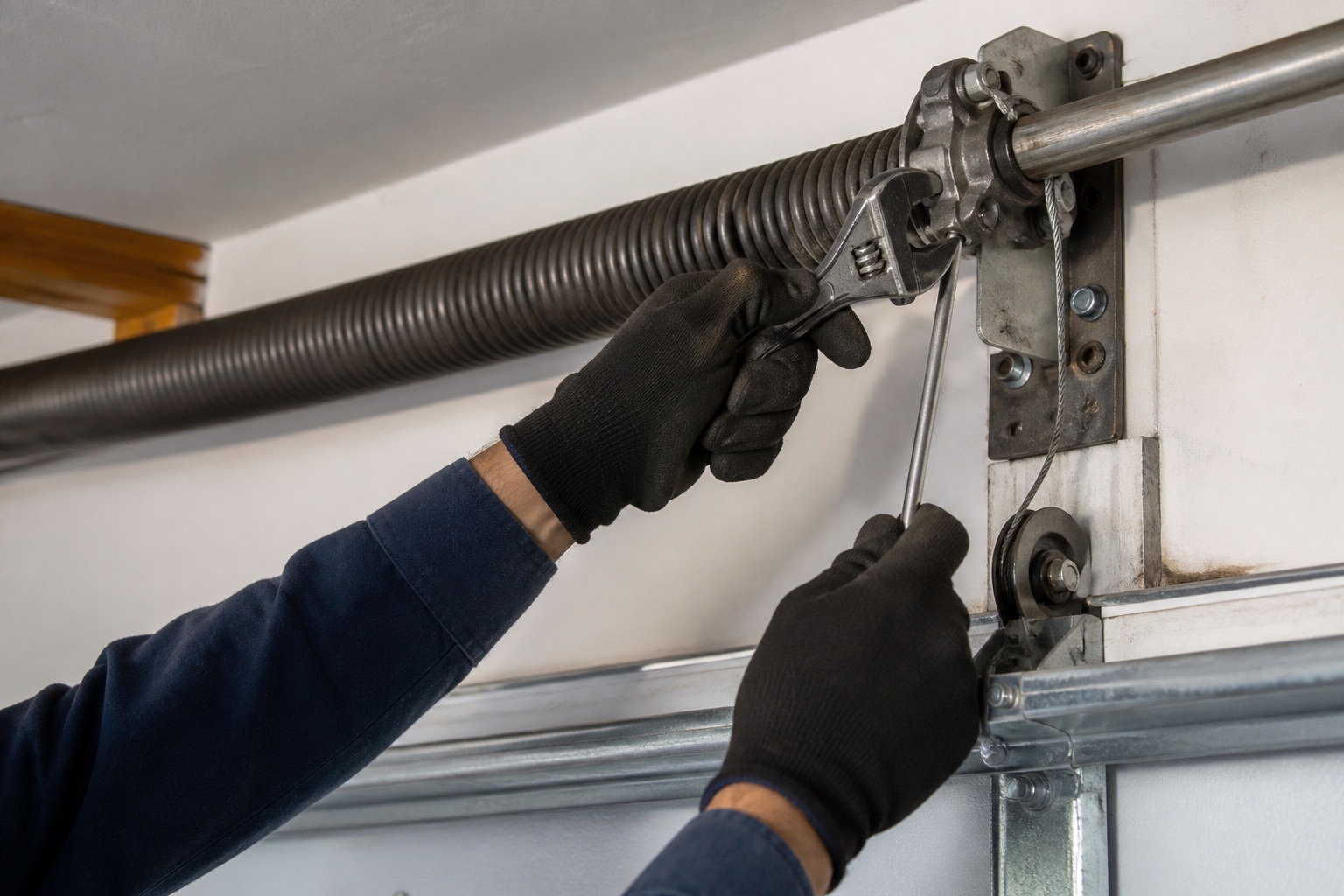
- Torsion spring replacement. Torsion springs sit above the door on a horizontal shaft. They're pre-wound to store the rotational energy needed to counterbalance the door's weight — typically 30–60 foot-pounds of torque in a standard residential spring. Unwinding or winding a torsion spring requires specific tools (winding bars that fit the cone) and technique. A winding bar that slips under load releases that energy instantly, directly toward whoever is holding it.
- Extension spring replacement. Extension springs run parallel to the horizontal tracks. They're under full stretch tension when the door is closed. A spring that snaps during removal sends metal fragments at high velocity. A safety cable running through the center of the spring is supposed to contain a broken spring — but it only works if properly installed, and many existing installs don't have them.
- Cable drum work. The cables connect the door bottom to the spring drums. If a spring is involved in the repair, the cable side carries the same risk profile as the spring work itself.
- Track realignment after an off-track event. If the door came off the track in a wind event or was forced, the spring and cable system may be unbalanced. Work on the tracks without first neutralizing that tension is risky.
The winding bar problem
The most common DIY injury scenario for torsion springs involves improvised winding bars. Proper winding bars are solid steel rods that fit exactly into the winding cone holes. The wrong size — a screwdriver, a piece of rebar, a hex key — can slip under the torque load. When it slips, the spring unwinds violently and whatever was holding the bar gets struck by it, the bar itself, or both.
Even with correct tools, the process requires knowing how many turns the specific spring requires (calculated from door weight and spring specs) and maintaining control throughout. It's a learnable skill — but "learnable" doesn't mean "safe on the first attempt without guidance."
What a tech actually does that you probably can't
Beyond the tools, a tech brings two things that matter:
- Spring sizing knowledge. Installing the wrong spring — wrong wire diameter, wrong length, wrong turns count — creates a door that's unbalanced. This stresses the opener motor, wears cables unevenly, and can make the door fall if the opener fails. Getting the right spec requires knowing the door's exact weight and doing the math.
- Inspection while they're there. A spring replacement visit is also when a tech can catch cables that are about to fray, rollers that are cracking, or a track that's slightly bent. Problems caught at the same time as a spring replacement cost nothing extra to address.
FAQ
DIY safety FAQ
Can I replace a garage door spring myself?
Technically yes — torsion and extension spring replacement is documented online and the parts are available. But torsion springs store a significant amount of tension energy, and an improper release can cause serious injury. Most techs advise against DIY spring replacement unless you have specific mechanical training and the proper winding bars. Extension springs are somewhat less dangerous but carry the same fundamental risk if the door isn't properly supported during the swap.
What garage door repairs are safe to DIY?
Safe DIY territory: lubricating hinges, springs, and rollers; replacing a worn bottom seal; cleaning and realigning safety sensors; reprogramming remote codes; replacing a keypad battery; tightening loose hinge bolts. Anything involving spring tension, cable drums, or track hardware warrants a second thought.
How much tension is in a garage door spring?
A standard residential torsion spring is typically wound to store 30–60 foot-pounds of torque — enough to cause a severe laceration or fracture if it releases suddenly. The energy is stored by winding the spring tight around a shaft. If the spring breaks or a winding bar slips, that energy releases in milliseconds.
Is it worth saving money by doing spring replacement myself?
A professional spring replacement typically costs $189–$350. An ER visit costs considerably more, and that's before considering lost work time and recovery. For most homeowners, the math favors calling a tech. The one exception: someone with genuine mechanical experience who understands the risks and has the correct tools.
Ready when your door isn’t
Need garage door help today?
Tell us what’s wrong. We’ll confirm options and timing — including whether same-day dispatch is realistic — before any work begins.